
Quick answer: Yes, by a clear margin. Over the same 13 seasons, home teams in MLS and Brazil's Serie A won almost half of their matches. Away teams won only one in four. Both leagues show a bigger home advantage than every one of the 22 European leagues in our database.
We added MLS and Brazil Serie A to Dedicated Betting this season. This is the first time we have been able to put them alongside the European data and ask a simple question: does playing at home matter more in the Americas?
Key takeaway: MLS home teams outscore their visitors by +0.52 goals per match and Brazilian home teams by +0.47. The European top-flight average over the same period is +0.34. Away teams win 30% of European top-flight matches, but only around 25% in MLS and Brazil.
How We Compared the Leagues
European football has 30-plus years of results in our database. MLS and Brazil have far less history, so a fair comparison needs the same time window for everyone.
We used seasons starting from 2012 to 2025. MLS and Brazil play calendar-year seasons, so MLS 2015 is compared with the European 2015-16 season.
The 2020 season is excluded from the main comparison. That covers MLS 2020, Brazil 2020 and European 2020-21, when most matches were played behind closed doors. We look at that season separately later, because it turns out to be one of the most revealing parts of the analysis.
That leaves:
| League group | Leagues | Seasons | Matches |
|---|---|---|---|
| MLS | 1 | 13 | 5,252 |
| Brazil Serie A | 1 | 13 | 4,899 |
| European top flights | 11 | 13 | 44,976 |
| All European leagues | 22 | 13 | 100,231 |
The measures are the same ones used in our home advantage pillar article: home win rate, home goal advantage per match and points per game at home and away.
MLS and Brazil Top the Home Advantage Table
Ranked by home goal advantage, MLS and Brazil sit first and second out of all 24 leagues.
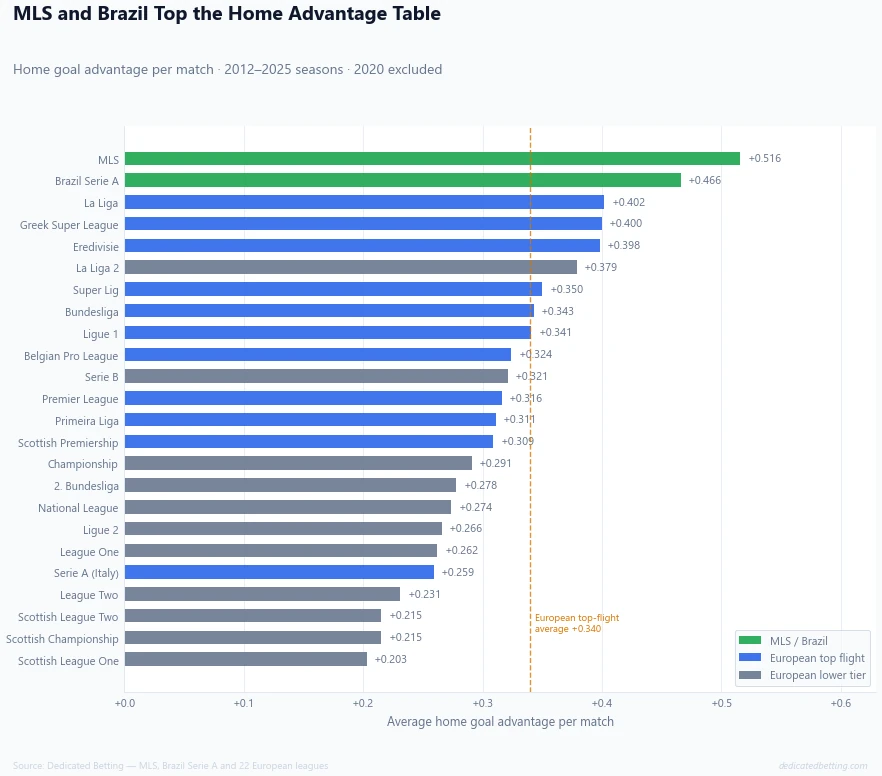
MLS leads at +0.516 goals per match. Brazil follows at +0.466.
The strongest European competition over the same seasons is La Liga at +0.402, closely followed by the Greek Super League and the Eredivisie. The Premier League sits at +0.316, below the European top-flight average of +0.340.
That makes MLS home advantage about 52% larger than the European top-flight average, and Brazil's about 37% larger.
Away Teams Win One in Four
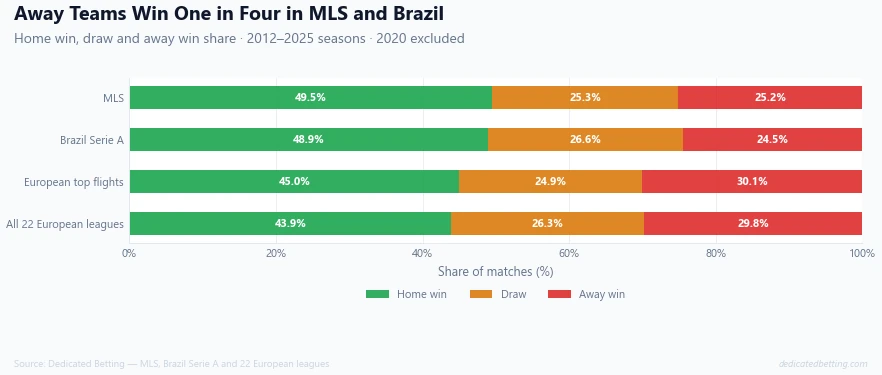
The scale of the difference is clearest in how matches finish.
| League group | Home win % | Draw % | Away win % |
|---|---|---|---|
| MLS | 49.5% | 25.3% | 25.2% |
| Brazil Serie A | 48.9% | 26.6% | 24.5% |
| European top flights | 45.0% | 24.9% | 30.1% |
| All European leagues | 43.9% | 26.3% | 29.8% |
Draw rates are broadly similar everywhere. The difference comes almost entirely from away wins moving into the home column. A European top-flight away side wins roughly three matches in ten. In MLS and Brazil, that falls to one in four.
Points per game tell the same story:
| League group | Home PPG | Away PPG | Home minus away |
|---|---|---|---|
| MLS | 1.74 | 1.01 | 0.73 |
| Brazil Serie A | 1.73 | 1.00 | 0.73 |
| European top flights | 1.60 | 1.15 | 0.45 |
An average MLS or Brazilian team earns around 0.73 more points per match at home than away. In European top flights, the gap is 0.45. Playing at home is worth roughly 60% more in MLS and Brazil.
The average away return in both MLS and Brazil Serie A, almost exactly one point per match. European top-flight away teams average 1.15.
The leagues reach that edge in different ways. MLS is a high-scoring league at 2.90 goals per match, behind only the Eredivisie and Bundesliga among top flights, with home sides scoring 1.71. Brazil is much tighter at 2.38 goals per match, and its edge comes from suppressing visitors: away teams score just 0.96 goals per match.
Has It Changed Over Time?
Season by season, both leagues have spent most of the period above the European level. MLS has not always stayed there.
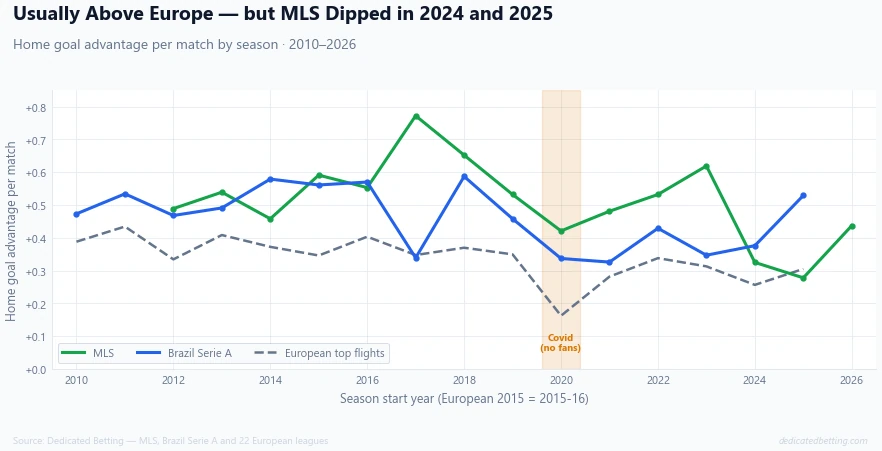
MLS peaked at +0.77 in 2017. It then fell to +0.33 in 2024 and +0.28 in 2025. That 2025 figure is slightly below the European top-flight level for 2025-26 (+0.31). The completed 2026 regular season recovered to +0.44.
Brazil has been steadier. It dipped to around +0.33 in 2017 and again in 2020 and 2021, but reached +0.53 in 2025.
Single seasons need care. With around 500 matches in an MLS season, swings of roughly ±0.15 goals per match from one year to the next are expected by chance alone. The 2024 and 2025 MLS seasons sit outside that range compared with the league's longer-run level, so the dip looks real. One recovered season is not yet enough to say whether it has fully reversed.
What Happened Without Fans?
The 2020 season is the closest thing football has had to a natural experiment. Most matches were played behind closed doors, which removed the crowd from the home advantage equation.
Our crowd analysis shows how sharply home advantage fell across Europe. Comparing MLS and Brazil with the European top flights adds something new.
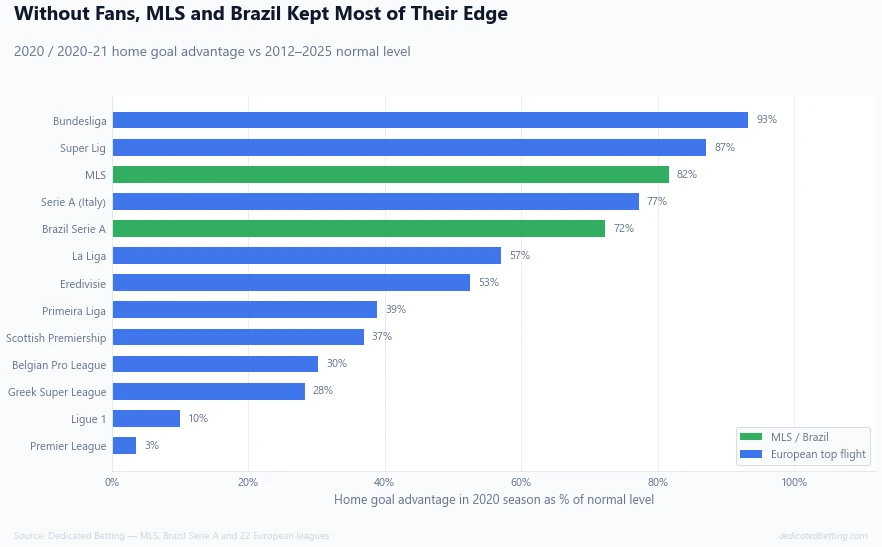
Pooled together, the European top flights kept less than half of their usual home advantage (+0.16 against +0.34). Some collapsed almost entirely. The Premier League kept just 3% of its normal edge and Ligue 1 kept 10%.
MLS kept 82% of its home advantage. Brazil kept 72%.
| League | Normal home goal advantage | 2020 season | Share kept |
|---|---|---|---|
| Bundesliga | +0.34 | +0.32 | 93% |
| Super Lig | +0.35 | +0.31 | 87% |
| MLS | +0.52 | +0.42 | 82% |
| Brazil Serie A | +0.47 | +0.34 | 72% |
| La Liga | +0.40 | +0.23 | 57% |
| Premier League | +0.32 | +0.01 | 3% |
The MLS figure is more striking given that its 2020 season included a tournament played at a single neutral venue in Florida. Canadian clubs also played their "home" fixtures in US stadiums. Both should have pushed the number down.
Two points stop this from becoming a neat conclusion. First, the Bundesliga and Turkey's Super Lig kept even more of their edge than MLS, so holding on to home advantage without fans is not unique to the Americas. Second, a single season is a small sample for each league.
What the data does show is that crowds appear to explain a smaller share of home advantage in MLS and Brazil than in most of Europe.
Why Might Home Advantage Be Bigger There?
If the crowd is not the main driver, something else must be. The explanations most often given for MLS and Brazil are structural:
-
Travel distance. Both leagues cover continental distances. MLS spans several time zones and two countries, and Brazil is a country of continental size. Long away trips are routine rather than occasional.
-
Altitude. Some clubs play at significant elevation. Altitude is often cited as a source of home advantage because even elite athletes can be affected by thinner air when they are not fully acclimatised.
-
Climate. Clubs play in very different conditions, from humid southern US cities to cooler northern ones, and from Brazil's tropical north to its temperate south. Visiting teams regularly play in conditions their home climate does not prepare them for.
The team-level data is consistent with these ideas. The five MLS clubs with the biggest home-away gap include two high-altitude clubs, Colorado Rapids and Real Salt Lake, and two from hot southern cities, Houston and Dallas.
Consistent is not the same as proven, though. We have not yet measured travel distance or climate directly, so this analysis cannot say how much each factor contributes. That is a question for a future article.
Which Teams Have the Biggest Home Edge?
Among teams with at least five seasons in the window, these have the largest gap between home and away points per game.
MLS
| Team | Seasons | Home PPG | Away PPG | Gap |
|---|---|---|---|---|
| Houston Dynamo | 13 | 1.73 | 0.78 | +0.95 |
| FC Dallas | 13 | 1.873 | 0.95 | +0.92 |
| Portland Timbers | 13 | 1.87 | 0.97 | +0.90 |
| Colorado Rapids | 13 | 1.67 | 0.79 | +0.87 |
| Real Salt Lake | 13 | 1.90 | 1.03 | +0.87 |
Only one qualifying MLS club earned more points away than at home: FC Cincinnati, with a gap of −0.08 over six seasons. The typical MLS club's gap was 0.74 points per game.
Brazil Serie A
| Team | Seasons | Home PPG | Away PPG | Gap |
|---|---|---|---|---|
| Atletico Paranaense | 11 | 1.92 | 0.94 | +0.98 |
| Ponte Preta | 5 | 1.67 | 0.75 | +0.93 |
| Coritiba | 8 | 1.60 | 0.69 | +0.91 |
| Santos | 12 | 1.91 | 1.02 | +0.89 |
| Internacional | 12 | 1.92 | 1.07 | +0.85 |
Ponte Preta last played in Serie A in 2017.
No qualifying Brazilian club earned more points away than at home, and the typical gap was 0.76.
The smallest gaps tend to belong to the strongest teams. Palmeiras had the best home record of any Brazilian club in the window at 2.01 points per game, but its gap was only 0.56 because it also averaged 1.45 points away. A team good enough to win anywhere has less to gain from home conditions.
What Does This Mean for Bettors?
The honest answer is that we cannot yet say whether the market prices MLS and Brazilian home advantage correctly. Historical odds for these leagues only start this season in our database, so there is not enough history to test betting returns.
The European evidence is a useful guide. In our analysis of home advantage and betting, blindly backing home teams lost money in every one of 22 European leagues, including those with strong home advantage. A bigger home edge did not mean better returns, because the odds already reflect it.
There is no reason to assume MLS or Brazil will be different. The practical value of this analysis is context:
-
Use the right baseline. A home team in MLS or Brazil starts with a bigger expected edge than one in the Premier League or Serie A. Applying European assumptions to these leagues will underrate home sides.
-
Check the team, not just the league. The league average hides wide variation. Our MLS and Brazil Serie A league and team pages show current home and away splits.
-
Watch recent seasons in MLS. The 2024 and 2025 dip shows the league's home edge is not fixed. A baseline built on 2015–2019 alone would have overstated it.
We will revisit the betting question once enough odds history has built up.
Limitations
- MLS and Brazil have 13 seasons in the comparison window, compared with more than 30 for most European leagues. That is enough for clear league-level differences but leaves single-season figures noisy.
- The 2020 season is excluded from the main comparison. The end of the European 2019-20 season and parts of 2021 were also played with no or limited crowds, and those seasons remain in the window.
- Canadian MLS clubs played some 2021 home matches in US stadiums. These are fewer than 0.5% of the MLS matches in the comparison and do not change the conclusions.
- Shared stadiums are common in Brazil, and clubs sometimes play home fixtures away from their usual ground. All matches are treated as home matches for the club listed as the home team.
- Clubs that changed their name appear under each name separately in the team tables.
Final Verdict
Is home advantage bigger in MLS and Brazil than in Europe?
Yes. Over the same 13 seasons, both leagues showed a larger home edge than every European league in our database. Home teams won around half their matches, and away teams averaged roughly one point per game.
The closed-doors season adds a second finding. MLS and Brazil kept most of their home advantage without fans, while many European top flights lost most or nearly all of theirs. That points towards factors beyond the crowd, with travel, climate and altitude the most likely candidates.
Final thought: In Europe, home advantage has been shrinking towards the crowd effect alone. In MLS and Brazil, the journey itself still seems to matter.
Data from the Dedicated Betting database: 5,252 MLS matches, 4,899 Brazil Serie A matches and 100,231 matches across 22 European leagues, covering seasons starting 2012 to 2025 with 2020 excluded unless stated. MLS figures cover regular-season matches only. Historical patterns do not guarantee future results.
Related football articles
Home advantage in football: does it still matter?
Our pillar analysis covers 33 seasons of European home advantage, why it has declined and how it varies by league.
Do football crowds create home advantage?
What happened to home advantage when fans were removed, examined across the European leagues: Do Football Crowds Create Home Advantage?.
Which leagues have the biggest home advantage?
The full ranking of 22 European competitions across 30+ years: Which Football Leagues Have the Biggest Home Advantage?.