
Barcelona are La Liga champions for 2025-26 with 94 points, eight clear of Real Madrid, and built on a home record that was, in the most literal sense, perfect. Nineteen home games, nineteen wins, zero points dropped at Camp Nou.
Below is a full data-driven breakdown of the season: how the title was shaped, where the real stories were buried in the standings, what the betting market revealed, and why La Liga's data looks so strikingly different from other major European leagues.
All stats are drawn directly from our database covering the full 380-match campaign. You can explore the underlying data on the La Liga stats page.
Season at a Glance
| Champions | Barcelona - 94 pts |
| Runners-up | Real Madrid - 86 pts |
| Champions League | Barcelona, Real Madrid, Villarreal, Atlético Madrid, Betis |
| Europa League | Celta, Real Sociedad (Copa del Rey) |
| Conference League | Getafe |
| Relegated | Levante (42 pts), Girona (41 pts), Oviedo (29 pts) |
| Total goals | 1,024 across 380 matches |
| Average goals per game | 2.69 |
The table tells a story of two competitions running simultaneously. Barcelona and Real Madrid operating at a level the rest could not reach, and a bottom half where the margins between safety and the drop were extraordinarily tight.
How Barcelona Won the Title
Barcelona's title was built on their home record. Not just a strong home record, a perfect one. Across all 19 home fixtures they won every single match, averaging 3.00 points per game at Camp Nou. They scored 57 goals at home and conceded just 10, keeping 10 home clean sheets. No side in the division came to Barcelona and took anything, and no side in La Liga history in our database had previously managed that without dropping at least a point somewhere. Every other unbeaten home season included at least one draw.
Their away form backed it up convincingly too: 12 wins, one draw, six defeats, averaging 1.95 points per game on the road. The combination of both produced 95 goals for the season, the most in the division, against 36 conceded.
Key takeaway: Barcelona's perfect home record of 19W/0D/0L is the foundation of their title. Going unbeaten at home is something Barcelona and Real Madrid do periodically, but winning every single fixture without a single draw has never been done before in our database.
What the xPts data adds, however, is nuance. Barcelona's expected points were 88.2, Real Madrid's were 85.0. A gap of just 3.2 points in underlying terms, compared to the eight-point gap that appears in the final table. Barcelona genuinely deserved the title, but Madrid's campaign was closer to theirs in quality than the standings suggest. The gap in execution, rather than chance creation or defensive solidity, is where the eight points came from.
Real Madrid's home vulnerabilities were ruthlessly exposed at the wrong moments. Their two most shocking home defeats, 0-1 to Getafe (winner's odds: 10.52) and 0-2 to Celta (8.81), were among the biggest upsets of the season across any European league, and they both happened at the Bernabéu. A side that conceded seven home points to two opponents priced at 8.81 and 10.52 is not going to win a title against the team that dropped zero.
Was It a Predictable Season?
La Liga was noticeably more predictable than the English Premier League this season. Favourites won 54.5% of matches (compared to 49.5% in the PL) and the underdog won just 21.1% of the time. With only seven results producing a winner at 6.0 or higher, genuine upsets were relatively rare.
The season's most notable results:
| Date | Match | Scoreline | Winner's Odds |
|---|---|---|---|
| 02 Mar 2026 | Real Madrid vs Getafe | 0-1 | 10.52 |
| 07 Dec 2025 | Real Madrid vs Celta | 0-2 | 8.81 |
| 16 Feb 2026 | Girona vs Barcelona | 2-1 | 6.57 |
| 17 Aug 2025 | Espanyol vs Atlético Madrid | 2-1 | 6.25 |
The Getafe result at 10.52 was the single biggest upset across either of the two leagues we have reviewed this season. The fact that both of the top two results involved Real Madrid losing at home says everything about where their title challenge unravelled.
Goals, Scorelines, and Patterns
La Liga averaged 2.69 goals per game, slightly lower than the Premier League's 2.75, but with a very different profile underneath that headline figure. Exactly 50% of matches went over 2.5 goals. Only 3.9% of matches finished goalless, barely one in every 25 games. In a 380-match season, that is roughly 15 scoreless draws across the entire campaign.
The most revealing scoreline is the second most common one:
| Scoreline | Occurrences | % of season |
|---|---|---|
| 1-1 | 58 | 15.3% |
| 1-0 | 44 | 11.6% |
| 2-1 | 42 | 11.1% |
| 2-0 | 27 | 7.1% |
| 1-2 | 27 | 7.1% |
The 1-0 home win occurring in 11.6% of all matches, compared to just 5.8% in the Premier League, reflects something fundamental about La Liga's tactical character. Compact defending, quick transitions, and narrow wins are far more embedded in Spanish football than in England. Both teams scored in 56.6% of matches, but the frequency of single-goal home victories tells you this is a league where structure and defensive organisation tend to dominate away sides.
Real Betis drew 15 of their 38 matches - precisely as many as they won. Their record of 15W/15D/8L is an unusual profile for a team finishing fifth with 60 points and qualifying for the Champions League. Their home record alone (10W/6D/3L) was enough to accumulate significant points through draws that would have been losses for a less organised side.
La Liga's Home Fortress Effect
The home advantage gap in La Liga is significantly larger than in most European leagues. Home teams won 48.9% of matches this season while away sides won just 26.6%, a 22.3 percentage-point gap. For context, the same gap in the Premier League was 12.6 points. La Liga's home advantage is, by this measure, nearly double that of English football.
That dynamic played out at the extreme end in Elche, who produced one of the most dramatic home/away splits in the division. At home they went 9W/8D/2L, averaging 1.84 points per game. Away from home: 1W/5D/13L, averaging 0.42 points per game, a difference of 1.42 points per game between home and away. They conceded just 19 goals at home all season, and 38 away. It kept them in the division; their away form alone would have relegated them comfortably.
The inverse case was Celta, who were notably better away from home (8W/7D/4L, 1.63 ppg) than at their own ground (6W/5D/8L, 1.21 ppg). They were one of very few sides in the division to have a higher away points-per-game than home, and still managed Europa League qualification in sixth.
Overperformers and Underperformers
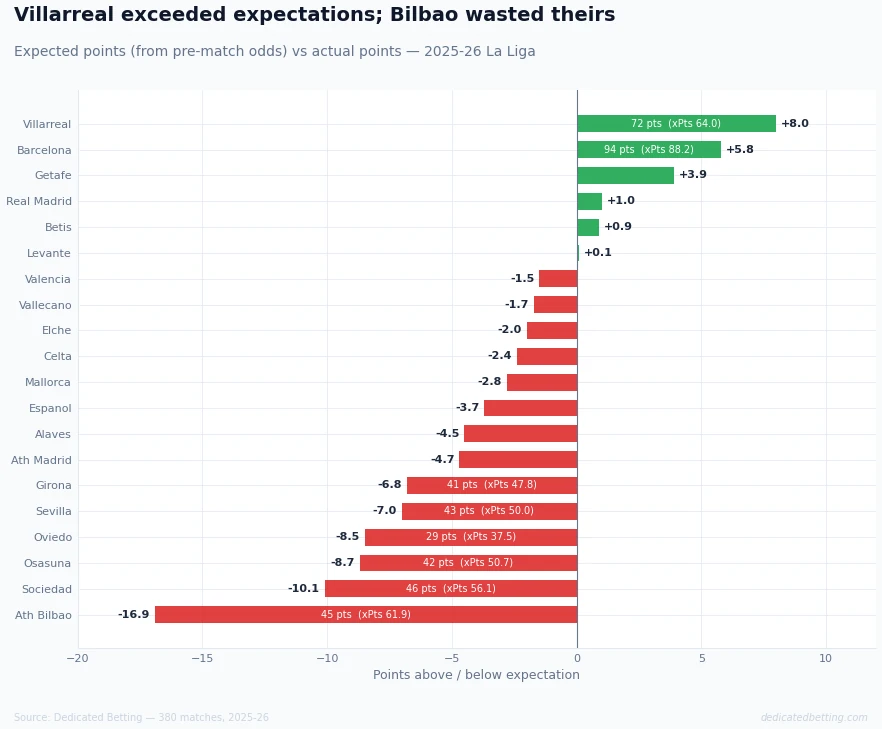
The three biggest overperformers:
| Team | Actual Pts | xPts | Difference |
|---|---|---|---|
| Villarreal | 72 | 64.0 | +8.0 |
| Barcelona | 94 | 88.2 | +5.8 |
| Getafe | 51 | 47.1 | +3.9 |
Villarreal's +8.0 is the standout. Third place and European football delivered on a points total the market consistently underestimated across the campaign. Barcelona's +5.8 reflects genuine quality converting into results, their perfect home record was not fortune, it was execution.
Getafe at +3.9 is the more surprising entry. A side that scored just 32 goals, the lowest of any European qualifier, reached the Conference League by conceding only 38 and keeping 12 clean sheets. The market undervalued them repeatedly, which feeds directly into their backing ROI story in the next section.
The three biggest underperformers:
| Team | Actual Pts | xPts | Difference |
|---|---|---|---|
| Athletic Bilbao | 45 | 61.9 | −16.9 |
| Real Sociedad | 46 | 56.1 | −10.1 |
| Osasuna | 42 | 50.7 | −8.7 |
Athletic Bilbao's -16.9 is the largest underperformance gap in the two league seasons we have reviewed so far, larger even than Chelsea's -16.3 in the Premier League. The market priced Bilbao as a top-six side throughout the season; they finished 12th with 45 points. Their away record was dire (4W/3D/12L, 0.79 ppg), and the gap between what the odds implied they were capable of and what they actually produced never closed at any point in the campaign.
Real Sociedad's -10.1 tells a similar story. Tenth in the league with 46 points, they salvaged Europa League football only through winning the Copa del Rey, a competition not reflected in any of the figures here. Their league season was significantly worse than the market anticipated. They also kept just three clean sheets across the entire 38-game campaign, a figure that alone explains how their results consistently fell short of expectations.
Betting Market Verdict
La Liga's market profile this season was, in several respects, the mirror image of the Premier League's.
| Bet | La Liga ROI | PL ROI |
|---|---|---|
| Back home team | +2.4% | −9.5% |
| Back draw | −15.1% | +6.5% |
| Back away team | −18.8% | −10.4% |
| Back favourite | +1.5% | −9.8% |
In the Premier League, the draw was the only profitable basic strategy and home backing lost heavily. In La Liga, the opposite: home and favourite both returned a small profit while backing draws was the most destructive approach, losing 15.1% across the season. This reflects La Liga's stronger home advantage and lower draw rate, the market priced draws at implied odds that were simply too generous relative to how rarely they occurred.
At team level, the differences were even sharper:
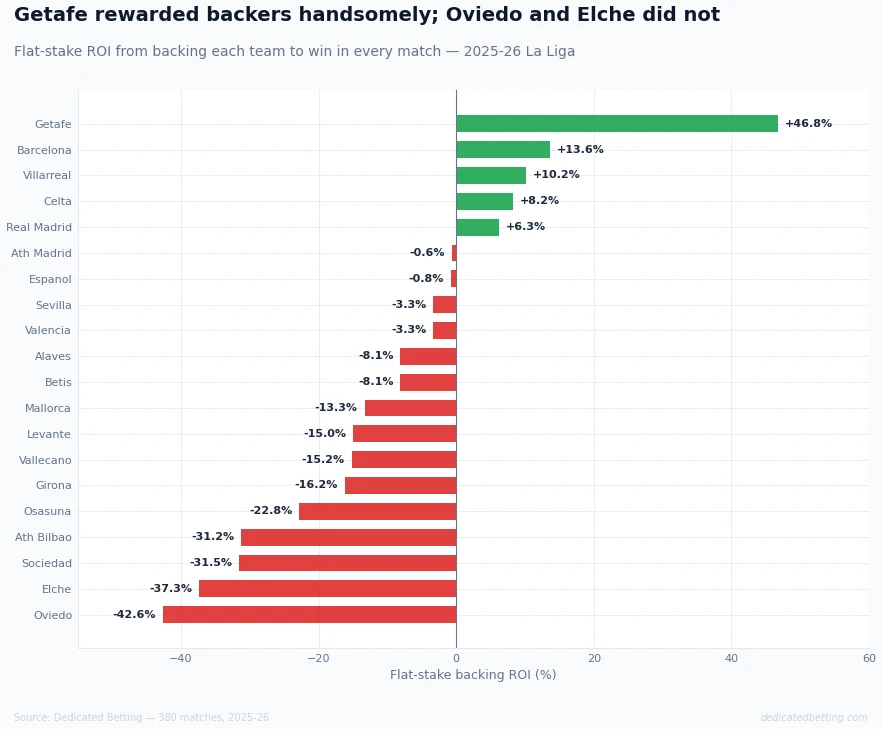
| Team | Backing ROI |
|---|---|
| Getafe | +46.8% |
| Barcelona | +13.6% |
| Villarreal | +10.2% |
| Celta | +8.2% |
| ... | |
| Sociedad | −31.5% |
| Athletic Bilbao | −31.2% |
| Elche | −37.3% |
| Oviedo | −42.6% |
Getafe's +46.8% is the headline. The market consistently priced them as a side that would lose, they were away underdogs for much of the season, and they consistently did not. Backing them in every match returned nearly half a stake in profit. Barcelona at +13.6% reflects their xPts overperformance: they were heavily priced as favourites at home and delivered every time, generating returns because short-odds wins accumulate.
At the other end, Athletic Bilbao's -31.2% is the financial consequence of their -16.9 xPts gap. The market priced them as winners in many matches they lost. Sociedad's -31.5% tells the same story. Oviedo's -42.6% reflects a relegated side that was routinely priced as a competitive threat and rarely proved to be one.
The Relegation That Was Decided by Goal Difference
The bottom of the table produced one of the tightest finishes seen in La Liga for some time. Three clubs - Osasuna, Mallorca and Levante - finished the season on exactly 42 points. The relegation places were settled entirely on goal difference: Osasuna survived at -6, Mallorca at -10, and Levante went down at -14. A single goal across the entire season could have changed which club dropped into the second tier.
Levante's situation is particularly harsh in historical context. Their 42 points represent the joint second-highest total ever recorded by a relegated team in La Liga's 20-team era. Only Deportivo La Coruña, who went down with 43 points in 2010-11, have been relegated from an 18th-place finish with more. In all the seasons since La Liga expanded to 20 teams, only three other sides, Getafe (2008-09), Zaragoza (2007-08) and Real Betis (1999-2000), have been relegated with the same 42-point total. By the standards of La Liga history, going down with 42 points is an extremely narrow miss, and Levante did it by 14 goals.
Looking Ahead to 2026-27
Barcelona's domestic dominance is clear, but the xPts data shows Real Madrid are closer than eight points suggests. The title race next season will likely hinge on whether Madrid can eliminate the home vulnerabilities, losing at home to sides priced at 10.52 and 8.81 is not something a title-winning side can afford.
Three further things the numbers flag for next season:
1. Athletic Bilbao need an explanation. A -16.9 xPts gap is not a rough patch, it is a systematic failure to perform at the level the market believed them capable of, sustained across 38 games. Whether that reflects injuries, tactical breakdown, or something else entirely, it is the biggest analytical question heading into 2026-27 for any club in the division.
2. Real Sociedad's Copa del Rey mask will not apply again. They finished tenth in the league, kept three clean sheets and underperformed expectations by ten points. Europa League football next season was earned in a cup competition, not through consistent league performance. The gap between their xPts and their actual points will be harder to paper over without another cup run.
3. Getafe's market edge may not last. Backing them returned +46.8% this season because the market consistently underpriced them. If bookmakers adjust their assessment of Getafe upward, as they inevitably will after a Conference League campaign, the odds that generated that return disappear. The underlying performance (+3.9 xPts) suggests genuine quality, but the extraordinary ROI was a market inefficiency as much as a footballing one.
Every stat in this article was tracked live throughout the season on our La Liga page and team pages. We'll be doing the same from day one of 2026-27 - bookmark us and get ahead of the market before the season starts.
Related articles
Premier League 2025-26 Season Review
The same treatment for the Premier League - Arsenal's title, Sunderland's return, Chelsea's collapse and where the betting market got it wrong: Premier League 2025-26 Season Review.
Does home advantage still matter in football?
La Liga's 22-point home win gap is one of the highest in European football. Our Home Advantage in Football analysis shows how it varies across leagues and what it means for betting.
Football betting bankroll management
The ROI figures in this article only tell part of the story - stake sizing determines whether you survive long enough to benefit. Our bankroll management guide covers the practical framework.