Bayern Munich lost one Bundesliga match in 2025-26. One. Across 34 games they won 28, drew five, and were beaten on a single occasion, at home. Away from home, they were entirely unbeaten: 14 wins, three draws, zero defeats.
That single statistic captures the season better than anything else. Below is the full data breakdown of what happened across 306 matches, including the most extraordinary individual upset across any of the three European leagues we have reviewed this season, the end of a 29-year Bundesliga story, and why the Bundesliga continues to be the most unusual league to bet on in Europe.
All stats are drawn directly from our database. You can explore the underlying data on the Bundesliga stats page.
Season at a Glance
| Champions | Bayern Munich - 89 pts |
| Runners-up | Borussia Dortmund - 73 pts |
| Champions League | Bayern, Dortmund, RB Leipzig, Stuttgart |
| Europa League | Hoffenheim, Bayer Leverkusen |
| Conference League | Freiburg |
| Relegated | Heidenheim (26 pts), St Pauli (26 pts), Wolfsburg (29 pts, playoff) |
| Total goals | 990 across 306 matches |
| Average goals per game | 3.24 |
The table settled into a familiar shape at the top. The stories that will define the season in memory are at the other end, and in the numbers that sit beneath the comfortable mid-table positions.
How Bayern Won the Title
The 16-point gap between Bayern (89 pts) and Dortmund (73 pts) understates the true distance between them. The xPts data, which models what each side's results should have been based on pre-match odds, puts Bayern at 86.5 expected points and Dortmund at 66.0. A gap of 20.5 points in underlying quality. Dortmund overperformed their expected points by seven, narrowing a 20-point structural gap to the 16 that appears in the final table.
Bayern's attacking output was extraordinary even by their own standards. Harry Kane scored 36 Bundesliga goals, more than double the next highest individual tally (Deniz Undav of Stuttgart with 19). Michael Olise added 19 assists. The club scored 122 goals across 34 matches, an all-time Bundesliga record in our database, surpassing their own previous best of 100 set in 2019-20 by 22 goals. Their goal difference of +86 means they conceded just 36 goals in a league averaging 3.24 goals per game, Bayern's defence held firm while everything else around them exploded into goals.
Key takeaway: Bayern's 122 goals is an all-time Bundesliga record. Their single defeat puts them joint second in the league's history for fewest losses in a full season, behind only Leverkusen's famous unbeaten campaign of 2023-24. By any measure, this was one of the most dominant title defences the division has seen.
Was It a Predictable Season?
Favourites won 54.9% of matches, virtually identical to La Liga's 54.5% and well above the Premier League's 49.5%. Underdogs won just 20.6% of the time, the lowest rate across all three leagues in this review.
That backdrop makes Augsburg's result at Bayern on 24 January 2026 all the more remarkable. Augsburg travelled to the Allianz Arena and won 2-1 at average odds of 20.62, the largest single-match upset recorded across any of the three leagues in this season's review. It is the kind of result that defines a campaign.
The season produced only three results at 6.0 or higher:
| Date | Match | Scoreline | Winner's Odds |
|---|---|---|---|
| 24 Jan 2026 | Bayern Munich vs Augsburg | 1-2 | 20.62 |
| 18 Apr 2026 | Leverkusen vs Augsburg | 1-2 | 6.64 |
| 28 Feb 2026 | Hoffenheim vs St Pauli | 0-1 | 6.29 |
Augsburg appear twice. Their role as the season's great disruptors goes well beyond two results as the market data in the final section shows.
A League Built for Goals
No major European league produces goals at the rate the Bundesliga does. At 3.24 per game this season, it sits comfortably ahead of the Premier League (2.75) and La Liga (2.69). The practical consequence: 63.7% of Bundesliga matches went over 2.5 goals, and 42.8% went over 3.5, meaning nearly one in every two games ended with at least four goals scored. For comparison, the Premier League's over 3.5 rate was 28.4%.
| Scoreline | Occurrences | % of season |
|---|---|---|
| 1-1 | 34 | 11.1% |
| 2-1 | 26 | 8.5% |
| 1-0 | 22 | 7.2% |
| 1-2 | 22 | 7.2% |
| 3-1 | 21 | 6.9% |
The 3-1 appearing in fifth place, at 6.9%, is the most obvious signal of what kind of league this is. In the Premier League, 3-1 occurred in just 5.3% of matches. Higher-scoring games produce bigger winning margins more frequently, and the Bundesliga scoreline distribution reflects that consistently. Only 3.9% of matches finished goalless, just 12 games across the entire season.
Both teams scored in 61.8% of fixtures. The Bundesliga is not a league that rewards set-and-defend approaches or produces many clean tactical matches. Goals come from both ends, often.
Home and Away
Home advantage exists in the Bundesliga but is more modest than in La Liga. Home teams won 43.8% of matches, above the away win rate of 31.7%, but a smaller gap than La Liga's near-22 percentage point split. Away teams actually won more often in the Bundesliga (31.7%) than in both the Premier League (30.0%) and La Liga (26.6%).
Bayern Munich illustrate the extreme end of this. Their only defeat came at home, in a season where they were entirely unbeaten on the road. More unusual still, their away record (2.65 ppg) was fractionally better than their home record (2.59 ppg). No other Champions League-qualified side can say the same.
At the other extreme, Wolfsburg managed just two home wins all season - a record of 2W/4D/11L at home, averaging 0.59 points per game at the Volkswagen Arena. They were, paradoxically, more competitive away from their own ground (5W/4D/8L, 1.12 ppg), a pattern common to sides under severe pressure whose home support turns. The home record alone tells the relegation story before the xPts data even needs to.
Freiburg present the mirror image of what Conference League football looks like when it depends on home form. They went 9W/5D/3L at home (1.88 ppg) but 4W/3D/10L away (0.88 ppg). Their European place was earned almost entirely at the Schwarzwald-Stadion.
Overperformers and Underperformers
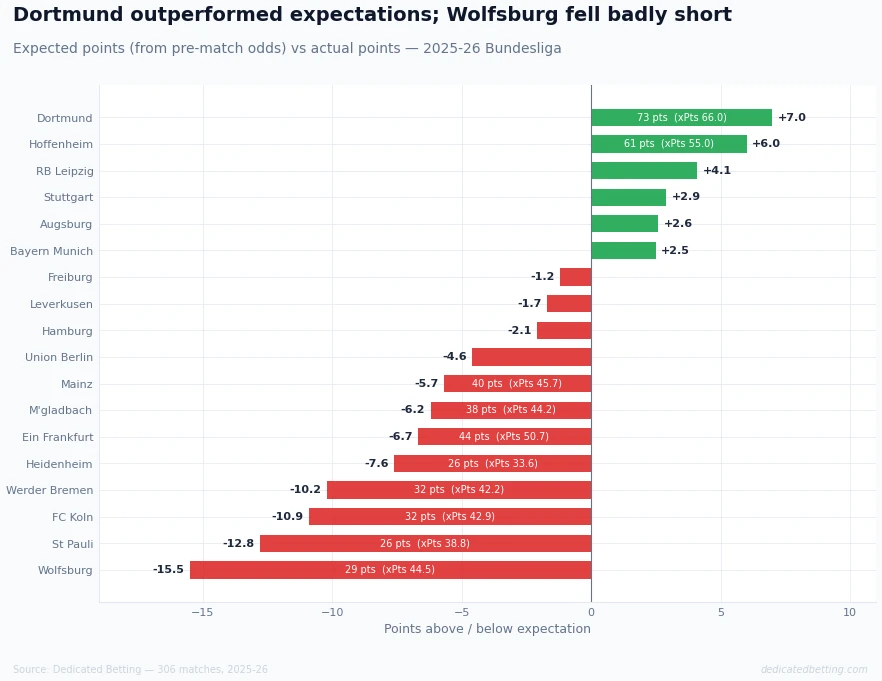
The three biggest overperformers:
| Team | Actual Pts | xPts | Difference |
|---|---|---|---|
| Dortmund | 73 | 66.0 | +7.0 |
| Hoffenheim | 61 | 55.0 | +6.0 |
| RB Leipzig | 65 | 60.9 | +4.1 |
Dortmund's +7.0 is substantial. It made the title race look like a 16-point affair when the underlying quality gap was closer to 20. Without their overperformance, they would have finished on roughly 66 points, a full 23 behind Bayern. The question heading into next season is whether that overperformance is repeatable or whether a correction brings them closer to their true level.
The three biggest underperformers:
| Team | Actual Pts | xPts | Difference |
|---|---|---|---|
| Wolfsburg | 29 | 44.5 | −15.5 |
| St Pauli | 26 | 38.8 | −12.8 |
| FC Köln | 32 | 42.9 | −10.9 |
Wolfsburg's -15.5 is the defining number of the relegation story. The market priced them as a solid mid-table side throughout the season, their expected points of 44.5 would have placed them comfortably in mid-table. What happened on the pitch told a completely different story, and the gap never closed. St Pauli's -12.8 is similarly stark: a team the odds said should have stayed up with relative comfort, who ended up going down automatically.
Betting Market Verdict
The Bundesliga is the first of the three leagues in this review where all four basic flat-stake strategies produced a loss.
| Bet | Bundesliga ROI | La Liga ROI | PL ROI |
|---|---|---|---|
| Back home team | −15.8% | +2.4% | −9.5% |
| Back draw | −3.4% | −15.1% | +6.5% |
| Back away team | −10.3% | −18.8% | −10.4% |
| Back favourite | −2.2% | +1.5% | −9.8% |
Home backing at -15.8% was the worst of any strategy across all three leagues reviewed. The draw came closest to break-even at -3.4%, which makes sense in a high-scoring league where draws are relatively uncommon (24.5%) and the market prices them generously. Favourite backing at -2.2% was the least damaging approach.
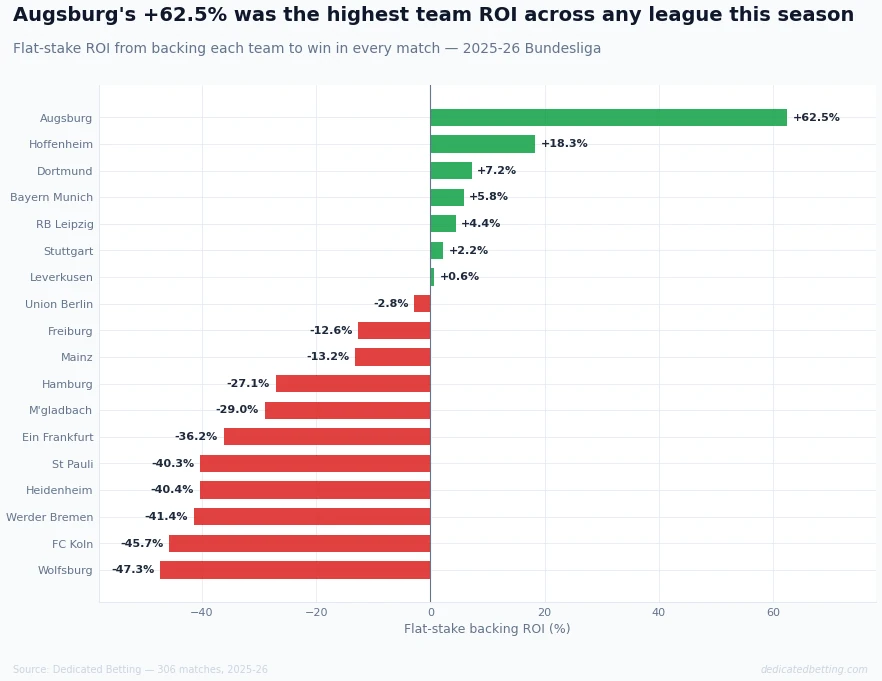
At team level, one side stands apart from everything:
| Team | Backing ROI |
|---|---|
| Augsburg | +62.5% |
| Hoffenheim | +18.3% |
| Dortmund | +7.2% |
| Bayern Munich | +5.8% |
| ... | |
| Werder Bremen | −41.4% |
| FC Köln | −45.7% |
| Wolfsburg | −47.3% |
Augsburg's +62.5% is the highest individual team ROI recorded across any of our covered leagues this season (see rankings page). It was built on a combination of the market consistently underpricing them, their two wins against Bayern (20.62) and Leverkusen (6.64) returned enormous value, and a season-long pattern of outperforming their odds. Their xPts gap of +2.6 is relatively modest, meaning the ROI was not driven by sustained overperformance but by the timing of when their upsets arrived. The market will price them very differently next season.
The Relegation Three
Heidenheim and St Pauli were relegated with records so similar that the numbers become absurd. Both finished on 26 points. Both had a goal difference of -31. Both went 6W/8D/20L. The only separation between them in the final table was goals scored, Heidenheim managed 41 across the season, St Pauli just 29, the fewest of any Bundesliga side. They were separated by goals scored across the entire season having matched each other in every other statistical measure. St Pauli finished bottom.
Wolfsburg's story carries the most weight. Our database records them in every Bundesliga season from 1997-98 onwards without a single gap, 29 consecutive seasons of top-flight football confirmed, ending with a 2-1 playoff defeat to SC Paderborn. Their -15.5 xPts gap, their two home wins across 17 home games, their -47.3% backing ROI, every metric pointed in the same direction across the entire campaign. The playoff result was confirmation, not surprise. For a club that has been a permanent fixture of German top-flight football since the late 1990s, it is the end of a significant era.
Looking Ahead to 2026-27
Bayern's dominance shows no statistical signs of abating. A 20.5-point quality gap to their nearest rival, an unbeaten away record and 122 goals suggest the Bundesliga title race will begin next season with the same foregone conclusion unless something structural changes at the Allianz Arena.
Three things the data flags beyond that:
1. Dortmund's +7.0 overperformance needs scrutiny. Second place looks like progress. But the gap to Bayern in underlying quality is wider than the points table shows. If Dortmund revert toward their expected level next season, the gap grows rather than shrinks. A 66-point side does not challenge a 86-point side regardless of how well they perform.
2. Augsburg's ROI will correct. Backing them returned +62.5% this season because the market mispriced them repeatedly. After beating Bayern at 20.62 and Leverkusen at 6.64, the market will not offer those prices again. Their underlying xPts (+2.6) suggests genuine quality, but the extraordinary ROI was a pricing anomaly, not a structural edge.
3. Wolfsburg's return will be watched closely. A side the market expected to collect 44.5 points ending up relegated with 29 raises legitimate questions about what went wrong. Their return, in the 2. Bundesliga or eventually back in the top flight, will be one of the more interesting stories in German football over the next few seasons.
Every stat in this article was tracked live throughout the season on our Bundesliga page and team pages. We'll be doing the same from day one of 2026-27 - bookmark us and get ahead of the market before the season starts.
Related articles
Premier League 2025-26 Season Review
Arsenal's title, Sunderland's return, Chelsea's collapse and the one bet that paid all season: Premier League 2025-26 Season Review.
La Liga 2025-26 Season Review
Barcelona's perfect home record, Athletic Bilbao's collapse and the three-way relegation drama: La Liga 2025-26 Season Review.
Football betting bankroll management
With all four basic Bundesliga strategies losing money this season, stake sizing and patience matter more than ever. Our bankroll management guide covers the practical framework.