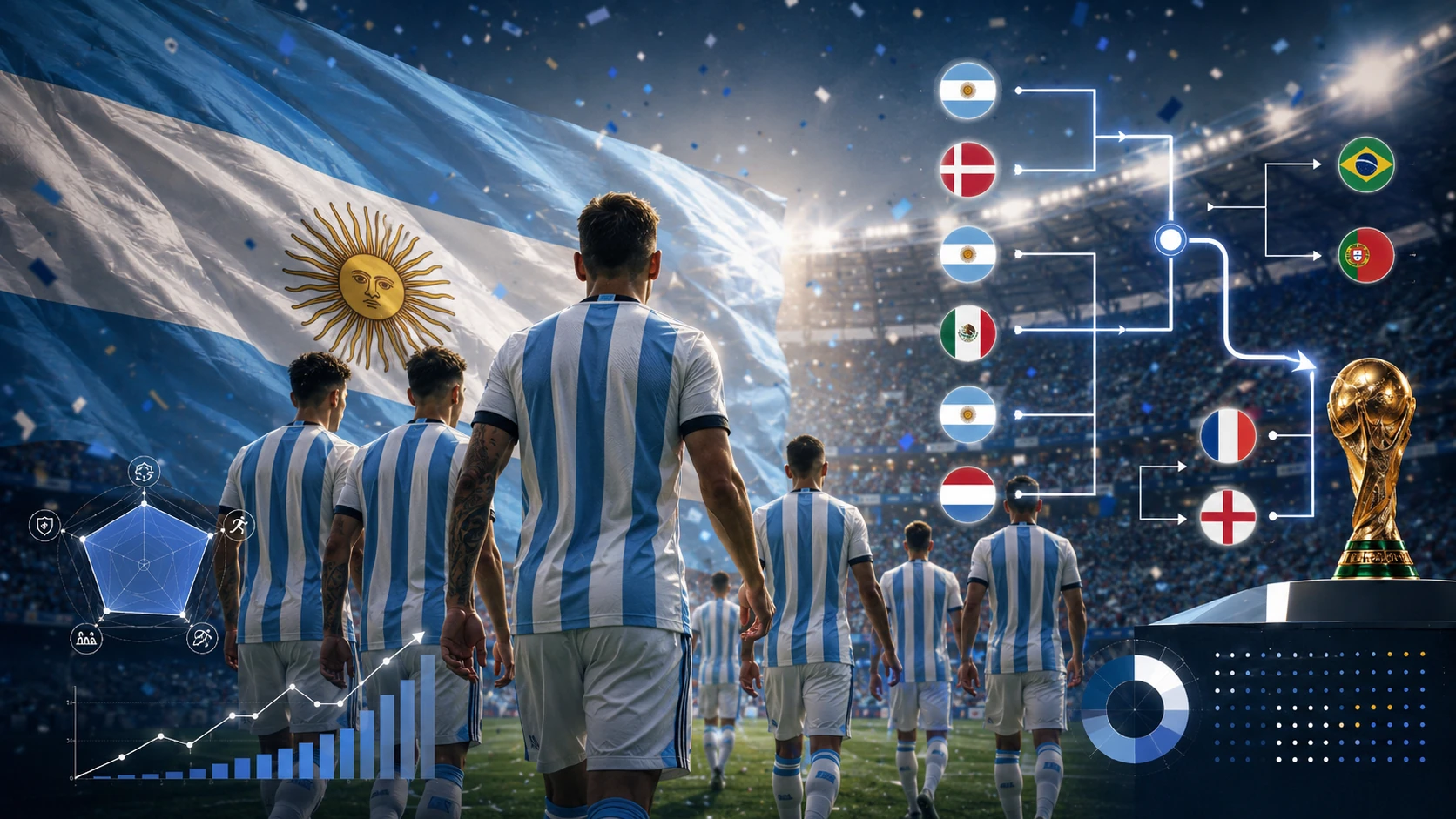
Before the 2022 World Cup final, Lionel Messi said that tournament would be his last. Lionel Scaloni was not so sure. "The door will always be open," the head coach said after their victory over France. In the end, Scaloni was right. Messi is in, and one of international football's longest-running sagas has reached its final chapter in North America.
Argentina arrive as defending champions, carrying a run of three consecutive international titles: Copa América 2021, World Cup 2022, Copa América 2024. No nation has matched that sequence in the modern era. Scaloni is attempting to become the first manager since Italy's Vittorio Pozzo, in 1934 and 1938, to win back-to-back World Cups. The model places them third in the field at 15.4%, behind Spain and France but ahead of every other nation.
For live group standings, fixtures and match analysis throughout the tournament, visit Argentina's World Cup 2026 team page.
The Group: Group J
Argentina are in Group J alongside Algeria, Austria and Jordan, the most manageable draw the defending champions could have received.
| Team | Avg Age | Model SF% |
|---|---|---|
| Argentina | 28.0 | 42.1% |
| Algeria | 26.0 | - |
| Austria | 27.5 | - |
| Jordan | 27.3 | - |
The group fixtures run: Algeria (16 June), Austria (22 June), Jordan (27 June). Messi will turn 39 between the Austria and Jordan games (on 24 June) becoming one of the oldest outfield players in World Cup history to still be active in group play. The model places Argentina as heavy Group J favourites at 67.3% to top it.
Algeria and Austria represent the only credible threats. Austria under Ralf Rangnick have punched above their weight in European football and should not be dismissed entirely, but Argentina's squad depth gives them significant advantages at every position. Jordan are ranked among the weakest sides in the tournament.
Argentina's qualifying campaign was dominant. They finished first in CONMEBOL, accumulating 38 points from 18 games, nine points clear of second-placed Ecuador, and became the seventh side to book their place at the tournament.
The Squad
Scaloni has retained 17 of the players who won the 2022 World Cup, including the core of Messi, Lautaro Martínez, Rodrigo De Paul, Enzo Fernández, Alexis Mac Allister, Emiliano Martínez and Cristian Romero. The continuity is deliberate. The identity of the squad, the "Scaloneta," as the Argentine press have nicknamed them, is built on the bonds of that 2022 campaign rather than on any single individual.
Ángel Di María, who scored the opening goal in the 2022 final against France, has retired from international football. His creative unpredictability from wide positions will be missed, and no obvious direct replacement exists in the squad.
The defensive concerns are the most significant uncertainty. Romero has battled injury problems. Nicolás Tagliafico had a difficult end to his club season at Lyon. Emiliano Martínez, so decisive in the penalty shootouts of Qatar, has shown occasional lapses of form at club level since. The goalkeeper remains one of football's most dominant figures in pressure situations but arrives with marginally less of the aura that surrounded him four years ago.
The average squad age is 28.0, the oldest Argentina have brought to a World Cup in recent memory. Valentín Barco (21) is the youngest player in the squad at the other end of the spectrum.

 Argentina · Attacker
Messi has played 26 World Cup matches, more than any player in history, and has scored 13 goals and contributed 8 assists across five tournaments. He turns 39 on 24 June during the group stage. The expectation is that Scaloni will manage his minutes carefully across a six or seven-match run, which shapes how Argentina's other forwards, Lautaro Martínez and Julián Álvarez, factor into the tournament's goalscoring narrative. This is almost certainly his final World Cup. See our Golden Boot analysis for why Argentina's route matters for the top scorer market.
Lautaro Martínez (Inter Milan) is the senior striker in the squad and among the most consistent finishers in European football. He scored the extra-time winner in the Copa América 2024 final against Colombia. His club goalscoring rate (0.57 per game) is solid and, with Messi managing his minutes, Lautaro's role becomes more central than it was in Qatar. At 30/1 in the Golden Boot market, the structure of Argentina's tournament run makes him one of the more compelling value plays available.
Emiliano Martínez has faced 33 penalties in competitive shootouts for club and country, saving 10, with a further two missed by the takers. His dominance in that specific context is among the most important quantifiable individual advantages Argentina carry into the knockout rounds.
Enzo Fernández (Chelsea) will take on greater creative responsibility in a squad where Di María is no longer available. His breakthrough at the 2022 World Cup, which triggered a £106m move to Chelsea, is still the defining moment of his international career.
Lionel Scaloni
Scaloni is 48 years old and has been Argentina's manager since 2018, initially appointed on a caretaker basis amid a wave of criticism following the 2018 World Cup failure. Diego Maradona publicly questioned whether he was qualified to manage Argentina, saying he "wouldn't even be able to direct traffic." He has since won three consecutive international tournaments.
His playing career was modest by the standards of his current reputation: 387 appearances across Spain, England and Italy, seven caps for Argentina, a loan spell at West Ham where he helped the club reach the 2006 FA Cup final. He was part of Argentina's 2006 World Cup squad without meaningfully contributing.
As a manager, he reversed those expectations entirely. His approach centres on squad unity, "Scaloneta" refers as much to the collective spirit he has fostered as to any tactical system. He told journalists he most admires Carlo Ancelotti's coaching style and tries to emulate it: calm, flexible, player-centred. The tactical detail varies by opponent; the constant is the group's belief in each other.
He became the youngest manager since 1978 to win the World Cup and the fourth youngest in history. His 2026 campaign would make him the first since Pozzo to win consecutive editions. His contract runs to the end of this tournament.
Argentina's World Cup History
Argentina have appeared in 19 World Cups and won three times - 1978, 1986 and 2022. They have reached the final five times. In 13 of their last 14 appearances, they have advanced beyond the group stage, the sole exception being the 2002 tournament.
The highlights:
- 1978 - Champions on home soil under César Luis Menotti. First World Cup triumph.
- 1986 - Champions in Mexico. Diego Maradona's tournament: the Hand of God goal and the Goal of the Century against England in the quarter-final. Argentina beat West Germany 3–2 in the final.
- 1990 - Final in Italy. Lost 1–0 to West Germany. Maradona in tears.
- 2014 - Final in Brazil. Lost 1–0 to Germany in extra time. Messi won the Golden Ball but has since said he wishes he had never accepted it.
- 2022 - Champions in Qatar. Messi's tournament: the 3–3 draw with France in the final, decided 4–2 on penalties. The 36-year wait between their second and third titles, only Italy's 44-year gap between 1938 and 1982 was longer in modern history.
Argentina's World Cup record (recent tournaments):
| Year | Round | Result |
|---|---|---|
| 2006 | Quarter-final | Lost to Germany (pens) |
| 2010 | Quarter-final | Lost to Germany 4–0 |
| 2014 | Final | Lost to Germany 1–0 AET |
| 2018 | Round of 16 | Lost to France 4–3 |
| 2022 | Final | Champions - beat France 4–2 (pens) |
What the Model Says
Argentina are the model's third most likely champions, behind Spain and France. Their semi-final probability of 42.1% is the third highest in the field.
| Stage | Probability |
|---|---|
| Win Group J | 67.3% |
| Reach Round of 32 | 96.7% |
| Reach Round of 16 | 70.0% |
| Reach Quarter-final | 54.7% |
| Reach Semi-final | 42.1% |
| Reach Final | 26.7% |
| Win Tournament | 15.4% |
Probability of advancing from Group J - Argentina are clear favourites in a group containing Algeria, Austria and Jordan.
Probability of reaching the quarter-finals - Argentina are more likely than not to be in the last eight.
Probability of reaching the semi-finals - the third highest of any team, fractionally behind Spain (45.8%) and France (42.6%).
Probability of reaching the final - behind Spain (31.1%) and France (27.6%) but ahead of every other nation in the field.
Probability of winning the tournament - third in the model behind Spain (21.2%) and France (18.0%).
The Route to the Final
Argentina's bracket path as group winners offers one of the more open routes to the semi-finals of any elite team in the draw.
Path A: Argentina win Group J (67.3% probability)
Round of 32 Opponents: Group H runners-up, most likely Uruguay (if Spain top Group H, which they are 74.1% likely to do). Uruguay under Marcelo Bielsa are experienced and organised, but Argentina would be firm favourites in what would be a classic South American rivalry tie.
Round of 16 Opponents: Winner from the Group B side of the bracket. Group B contains Qatar, Bosnia and Herzegovina, Canada and Switzerland, with Canada or Switzerland the likely group winners. This represents Argentina's most straightforward match of the knockout rounds.
Quarter-final Opponents: Winner from the Group D runners-up versus Group G runners-up bracket, most likely teams from Turkey, the USA, Belgium's second-place side, Iran or Egypt. None represent elite opposition at this stage.
Semi-final Opponents: Winner from the France/England/Netherlands bracket. France (42.6% SF probability) are the most likely semi-final opponent, a rematch of the extraordinary 2022 final, with the same narrative weight. England (27.4%) and the Netherlands (14.1%) are also credible from this side.
Final Opponents: Winner from the other semi-final, the Spain/Germany/Brazil bracket. A Spain vs Argentina final, with the model's first and third-most-likely champions meeting in the last match of the tournament, would be the defining game of the era.
As group winners, Argentina's path to the semi-finals runs through Uruguay, Canada or Switzerland, and a mid-ranking European side, an unusually clear run for a defending champion. The difficulty compresses into the final two rounds.
Path B: Argentina finish second in Group J (~33% probability)
Round of 32 Opponents: Group H winners, Spain (74.1% to top Group H). Argentina vs Spain in the Round of 32 is the most dramatic early-round fixture the draw can produce. The reigning world champions against the model's outright tournament favourites, in the fourth game of the tournament. This is the scenario the Spain article also highlights as the single most significant consequence of their group result.
Round of 16 onwards If Argentina beat Spain in that fixture, the subsequent bracket opens considerably, Canada or Switzerland in the R16, then a mid-table European side in the QF. The SF from Path B would most likely involve Germany (22.7% SF probability) or Brazil (16.0%).
Path B compresses the hardest fixture imaginable into the earliest possible knockout round, but if Argentina navigate it, they inherit a considerably easier path through to the final than Path A provides from the QF onwards.
Verdict
Argentina are the right third pick in this tournament. The squad has depth, the defensive core has continuity, Scaloni has won every major tournament he has entered, and the bracket as group winners is among the cleanest available to any top-four contender.
The dependency is honest and widely understood: this squad is built around Messi, and Messi at 39 is not Messi at 35. The preparation concerns, friendlies against Mauritania (FIFA 115) and Zambia (FIFA 91) as part of the warm-up programme, were legitimate. The AFA's off-field governance issues cast a peripheral shadow. And the defensive questions around Romero and Tagliafico are genuine, not trivial.
But Argentina under Scaloni have earned the benefit of the doubt. They have won three consecutive tournaments by finding solutions when they needed them, including from the bench, the Copa América 2024 winner was scored by a substitute in extra time, set up by two other substitutes, with all three introduced in the same minute. That capacity to change games is the hallmark of a well-drilled squad rather than an accident.
Three key numbers: 96.7% - the probability Argentina advance from the group. 42.1% - the probability they reach the semi-finals. 15.4% - the probability they defend their title.
For live predictions and match-by-match analysis throughout the tournament, see Argentina's World Cup 2026 team page and our World Cup 2026 predictions section.
Tournament probabilities from our World Cup 2026 model, based on FIFA ranking data and international results history. Squad statistics from the 2025–26 season. Bracket path analysis based on the confirmed 2026 World Cup knockout structure.
Related articles
Spain at the World Cup 2026
Spain's complete guide - the model's outright favourites and the team whose group result determines whether they face Argentina in the Round of 32 or the final: Spain at the World Cup 2026.
World Cup 2026 Golden Boot Odds
Lautaro Martínez at 30/1 - our data-driven breakdown of the top goalscorer market, including why Argentina's route makes him the strongest dark horse case in the field: World Cup 2026 Golden Boot Odds.
World Cup 2026 Predictions
Our model rates all 48 teams and simulates the full bracket. Spain lead at 21.2%, with Argentina third at 15.4%: World Cup 2026 Predictions.