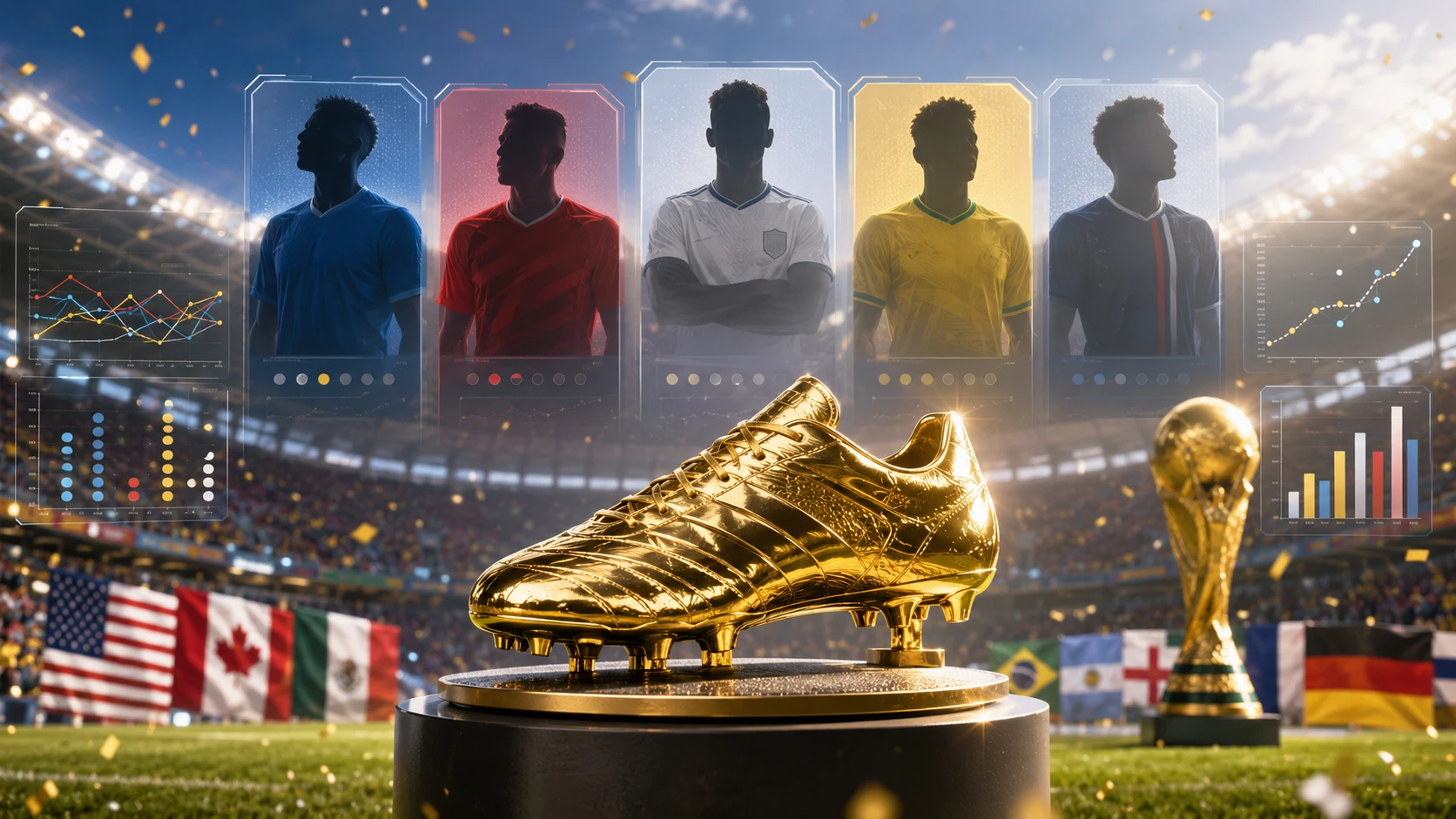
The World Cup 2026 Golden Boot is one of the most popular markets in tournament betting and one of the most commonly misread. Picking the best footballer in the world and backing them to outscore the field sounds simple enough. In practice, the top goalscorer award is determined as much by minutes, fixture opportunity, team depth and penalty duties as it is by individual talent.
Erling Haaland is arguably the most prolific striker in European football. He is priced at 12/1 for the Golden Boot, shorter than most of the players featured in this article. Norway have a 2.5% chance of reaching the semi-finals in our tournament model. Those two facts capture the central problem: a significant share of the Golden Boot market is priced on name recognition rather than genuine tournament opportunity.
This analysis works through the main candidates using our World Cup 2026 model data team semi-final probabilities, club season form, international conversion rates and penalty taker duties, to separate who the odds genuinely support from who is collecting money they do not deserve.
What It Takes to Win the Golden Boot
In the 32-team era (1998–2022), the Golden Boot has been won with between 5 and 8 goals, averaging 6.3. The clearest structural fact about this market is that the winner rarely plays for the champion nation. In seven tournaments since 1998, only Ronaldo in 2002 won the Golden Boot as part of the winning side. Šuker won it from third-placed Croatia in 1998. Klose and Müller both won it from third-placed Germany in 2006 and 2010. Kane won it from fourth-placed England in 2018. James Rodríguez won it in 2014 despite Colombia going out in the quarter-finals.
The consistent requirement is not team quality, it is minutes. Every Golden Boot winner in the 32-team era played in at least five matches. Teams that exit in the group stage provide three games. Teams that reach the semi-finals provide six or seven. That gap compounds significantly for a striker in form. The implication is clear: team progression probability is the single most important variable in this market, not individual talent rankings.
Three factors consistently shape Golden Boot outcomes:
- Team progression - the further a team goes, the more scoring opportunities accumulate
- Penalty duties - the designated taker typically adds one to two goals to their tally over a full tournament run
- National team role - some elite club players are not their country's primary finisher internationally; backing them at short prices for goals they are unlikely to score is a common mistake
The Contenders
The market leaders sit at 11/2 and 13/2. Both prices are broadly supported by the underlying data.
The stats beneath each player show: SF Prob - our model's probability of that nation reaching the semi-finals; Club G/G - goals per game in the 2025–26 club season; Int G/Cap - international goals per cap; Pen Taker - whether they are the designated penalty taker for their country; WC Goals - career World Cup goals across all tournaments.

 Real Madrid · France
The incumbent Golden Boot holder enters this tournament as its most experienced World Cup scorer - 12 goals in 14 appearances across two tournaments, including eight in Qatar. France have a 42.6% chance of reaching the semi-finals in our model, one of the highest in the field. Mbappé combines elite finishing, the penalty taker role and unmatched tournament pedigree in a way no other player in this market does. The 11/2 is tight but honest.

 Bayern Munich · England
Kane's club goalscoring rate of 1.16 per game is the highest of any player in this dataset - 36 goals in 31 Bundesliga appearances is exceptional output by any standard. His international conversion rate of 0.70 per cap is equally elite, and his 2018 Golden Boot was built substantially on penalties, a route that remains available here. England's semi-final probability (27.4%) is lower than France's, which explains why Kane sits marginally longer in the market. Given his scoring profile is arguably the strongest in the field, 13/2 looks like the better value of the two obvious favourites.

 Inter Miami · Argentina
Argentina share France's structural advantage at 42.1% semi-final probability, and Messi enters as the all-time leading World Cup scorer with 13 goals across five tournaments. Two significant caveats apply: he is 38 at tournament time, and his club form at Inter Miami, while solid in numbers, comes against MLS opposition rather than European competition. He is also not Argentina's designated penalty taker, which removes one of the most reliable scoring routes in tournament football. At 14/1 the price honestly reflects both the genuine opportunity and the real uncertainty about his capacity to sustain output across six or seven matches at this stage of his career.

 Real Sociedad · Spain
Spain have the highest semi-final probability of any nation in our model at 45.8%, and Oyarzabal is the designated penalty taker. His club form (0.44 goals per game at Real Sociedad) is the weakest of the four contenders and he has no World Cup goals to date, but in Spain's possession-based system a striker with the central role and spot-kick duties has significant accumulation opportunity even without elite conversion numbers. This is primarily a structural value play rather than a statement about Oyarzabal as an individual. Explore Spain's full tournament projections.
One to Watch: Lamine Yamal

 Barcelona · Spain
Yamal benefits from Spain's depth in the same way as Oyarzabal, but his role in the national setup is different. He is a right winger, not a central striker, and his international scoring rate of 0.24 goals per cap reflects a player who creates more than he finishes for Spain - with 12 assists in 25 appearances telling a more accurate story than the goals column. Oyarzabal is Spain's designated finisher and penalty taker. At 18/1, Yamal is attracting significant public interest driven in part by age and profile rather than Golden Boot suitability. He will score in this tournament; the question is whether the frequency matches the price.
The Dark Horses
At 30/1 and beyond, the value case requires a combination of genuinely longer odds, a team with real progression probability, and underlying numbers that hold up.

 Inter Milan · Argentina
Argentina's 42.1% semi-final probability gives Lautaro a structural platform that very few 30/1 shots in this market can match. He is a consistent elite-level scorer in Serie A and internationally averages 0.48 goals per cap, a solid number for a player in a squad also containing Messi. The well-known reservation is that Messi's presence concentrates Argentina's scoring narrative, and in Qatar Lautaro deferred heavily as the run progressed. If Messi manages his minutes carefully across a six or seven-match tournament and Lautaro claims a more central role, the 30/1 looks significantly mispriced. The strongest genuine dark horse in the market. See Argentina's projections.
 Barcelona · Spain
Spain's depth across a deep run creates a plausible path to meaningful minutes for multiple attackers. Torres brings decent numbers - 0.48 goals per game at Barcelona, 0.42 internationally, and a proven international track record. The honest caveat is that Oyarzabal has first claim on Spain's central striking role. Torres needs rotation or injury to accumulate the goals required. A speculative inclusion at 40/1 with Spain's structural case as the argument rather than Torres himself as the primary reason.
Also worth considering: Julian Álvarez (30/1) shares Argentina's strong structural position, his four World Cup goals in Qatar demonstrate genuine tournament scoring ability, but faces the same Messi-dependency question. Michael Olise (45/1) benefits from France's depth and is capable of goals from wide, but has limited international caps and needs France's tournament run to do the work.
The Overpriced
Two players whose prices cannot be reconciled with their structural opportunity.

 Manchester City · Norway
The clearest mispricing in the market. Haaland's individual numbers are extraordinary - an international scoring rate of 1.12 goals per cap is the highest of any player in this dataset, but Norway have a 2.5% chance of reaching the semi-finals. He will almost certainly play three group stage games. The Golden Boot has never been won with fewer than five goals in the 32-team era. Outscoring players from France, Argentina and Spain over a full tournament from a three-game platform would require something genuinely unprecedented. 12/1 is a price built entirely on name recognition. See Norway's tournament projections.
 Al-Nassr · Portugal
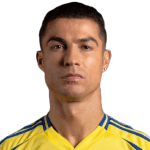
Ronaldo is 41 at this tournament and playing in the Saudi Pro League, which fundamentally limits what his club goalscoring rate of 0.93 per game tells you about his current level relative to World Cup opposition. Portugal's 21% semi-final probability is genuine, it is a solid number, but 20/1 prices a player capable of producing at or near his peak, which this version of Ronaldo is not. The market is partly reflecting the emotional weight of what is likely his final World Cup rather than a cold assessment of scoring probability. See Portugal's projections.
Full Market Data
The table below covers the top 20 players by market odds with the key metrics behind each price. SF% is our model's probability of that nation reaching the semi-finals. Club G/G is goals per game in the club season. Int G/G is international goals per cap.
| Player | Odds | Team | SF% | Club G/G | Int G/G | Pen | WC Goals |
|---|---|---|---|---|---|---|---|
| Kylian Mbappé | 11/2 | France | 42.6% | 0.81 | 0.58 | ✓ | 12 |
| Harry Kane | 13/2 | England | 27.4% | 1.16 | 0.70 | ✓ | 8 |
| Erling Haaland | 12/1 | Norway | 2.5% | 0.77 | 1.12 | ✓ | 0 |
| Lionel Messi | 14/1 | Argentina | 42.1% | 0.86 | 0.59 | – | 13 |
| Mikel Oyarzabal | 14/1 | Spain | 45.8% | 0.44 | 0.46 | ✓ | 0 |
| Lamine Yamal | 18/1 | Spain | 45.8% | 0.57 | 0.24 | – | 0 |
| Cristiano Ronaldo | 20/1 | Portugal | 21.0% | 0.93 | 0.63 | ✓ | 8 |
| Vinicius Junior | 25/1 | Brazil | 16.0% | 0.44 | 0.19 | – | 1 |
| Ousmane Dembélé | 25/1 | France | 42.6% | 0.46 | 0.12 | – | 0 |
| Julian Álvarez | 30/1 | Argentina | 42.1% | 0.28 | 0.28 | – | 4 |
| Lautaro Martínez | 30/1 | Argentina | 42.1% | 0.57 | 0.48 | – | 0 |
| Raphinha | 30/1 | Brazil | 16.0% | 0.59 | 0.29 | – | 0 |
| Kai Havertz | 35/1 | Germany | 22.7% | 0.17 | 0.37 | ✓ | 2 |
| Cody Gakpo | 40/1 | Netherlands | 14.1% | 0.19 | 0.40 | ✓ | 3 |
| Ferran Torres | 40/1 | Spain | 45.8% | 0.48 | 0.42 | – | 2 |
| Florian Wirtz | 40/1 | Germany | 22.7% | 0.15 | 0.28 | – | 0 |
| Michael Olise | 45/1 | France | 42.6% | 0.47 | 0.27 | – | 0 |
| Ollie Watkins | 50/1 | England | 27.4% | 0.43 | 0.30 | – | 0 |
| Romelu Lukaku | 50/1 | Belgium | 13.5% | 0.20 | 0.72 | – | 5 |
| Jamal Musiala | 50/1 | Germany | 22.7% | 0.20 | 0.22 | – | 0 |
Our Assessment
Three players have the strongest combined case across all variables: Kane (13/2), Mbappé (11/2) and Lautaro Martínez (30/1). The first two combine elite individual profiles with credible team progression and penalty duties. Lautaro offers Argentina's same structural opportunity as Messi at odds that reflect his secondary status in a narrative that may not hold across a full tournament.
For the market leaders, Kane at 13/2 looks marginally the better value, his club conversion rate is the highest in the dataset and England have a navigable draw. At 14/1, Oyarzabal's structural case (Spain's 45.8% semi-final probability plus penalty duties) is compelling even if his individual numbers are modest.
Among those to oppose, Haaland at 12/1 is the standout. The gap between his individual profile and Norway's tournament opportunity is larger than that of almost any other Golden Boot favourite in recent tournament history. The price belongs on a player with a realistic path to five or six matches, not three.
For full tournament predictions, group projections and team-by-team analysis, see our World Cup 2026 predictions section.
Team progression probabilities from our World Cup 2026 model, based on FIFA ranking data and international results history. Club statistics from the 2025–26 season. Odds correct at time of publication and subject to change. Not financial or betting advice.
Related articles
World Cup 2026 Predictions
Our model rates all 48 teams and simulates the full bracket. Spain lead the outright market, but the most interesting outputs are the nations where our model and the bookmakers diverge most significantly: World Cup 2026 Predictions.
World Cup 2026 Group Predictions
Every group broken down by qualification probability and group win chance, with the teams the market has mispriced at group level: World Cup 2026 Group Predictions.
World Cup 2026 Predictions and Analysis Guide
How to use our model data, H2H pages and team projections before each fixture throughout the tournament: World Cup 2026 Predictions Guide.